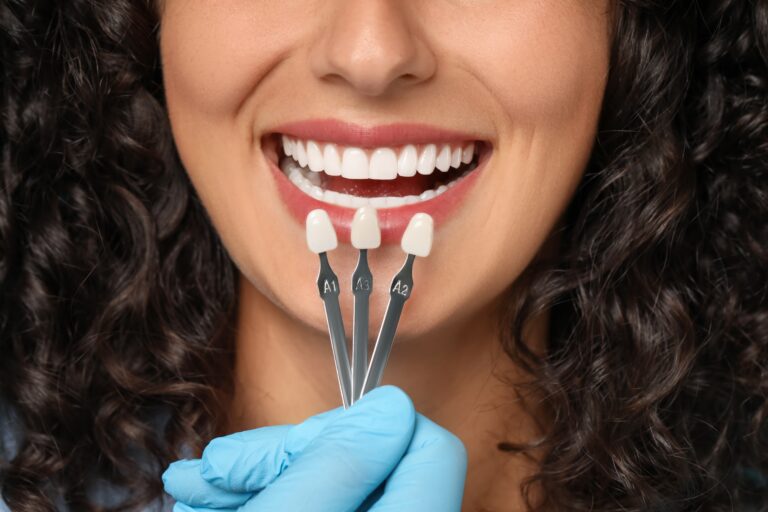
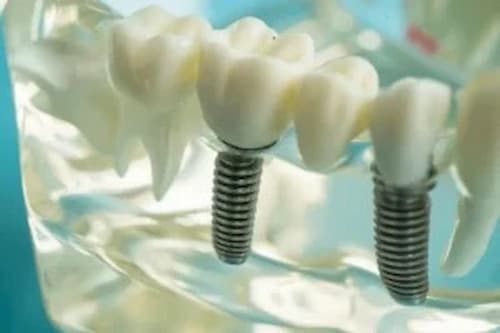
If you’re thinking about dental implants, you’ve probably wondered, “How many teeth can I replace at one time?” It’s a great question, and the answer is often more flexible than people expect. There’s no hard limit on how many teeth can be replaced during a single implant procedure. In fact, many patients have four to eight implants placed at once, which can support an entire row of 10 to 14 teeth. What works best for you depends on things like your jawbone strength, your overall health, and the treatment plan created specifically for your smile.
At The Foleck Center, we know that no two smiles—or patients—are exactly alike. That’s why we take a personalized approach to dental implants, using advanced tools like FDA-cleared Pearl AI diagnostic software to get a clear picture of your oral health. Whether you need to replace one tooth or you’re considering a full-arch solution, our team in Norfolk, Hampton, and Virginia Beach is here to make sure your care is comfortable, precise, and designed around your needs.
Can You Get Multiple Dental Implants at Once?
Yes. Many people believe there’s a hard cap on how many dental implants can be placed in one session. In reality, modern techniques and careful planning allow for the replacement of just one tooth, several teeth, or even an entire arch—all in a single procedure when appropriate.
Whether you need to replace one missing tooth or are considering a full-mouth solution, understanding your options is the first step towards a confident, functional smile.
How Many Teeth Can Be Replaced With Dental Implants?
You do not always need one implant for every tooth. Dentists can use implants as strong anchors, then attach a crown, bridge, or denture that replaces several teeth.
This matters for your time, comfort, and cost. Fewer implants can mean fewer surgical sites, while still giving you a stable bite and a natural look. Your dentist will look at your bone, your bite, and where the missing teeth sit before deciding how many dental implants you need.
Let’s break down some common scenarios.
Single Tooth Replacement
If you’re missing just one tooth, a single dental implant is usually all that’s needed. The implant acts as a stable foundation for a crown, giving you a natural-looking and fully functional replacement.
Multiple Tooth Replacement
When multiple teeth are missing next to each other, you don’t necessarily need an implant for each tooth. Often, two implants can support a dental bridge that replaces three or four teeth, restoring both your smile and your bite efficiently.
Full Arch Replacement
For patients missing most or all of their teeth in an arch, typically 4–6 implants are used to support a full set of 10–14 teeth. The All-on-4 and All-on-6 approaches are common in these cases.
- All-on-4: This method uses four strategically placed implants to support a full arch of 12–14 teeth, providing a stable and functional smile with fewer implants.
- All-on-6: Using six implants offers extra stability, which is especially helpful if jawbone density is lower or if additional support is desired.
Full Mouth Restoration
It’s possible to replace all teeth with 8–12 implants, usually 4–6 per arch. Depending on your treatment plan, this can often be accomplished in just one or two sessions, giving you a full, confident smile more quickly than you might expect.
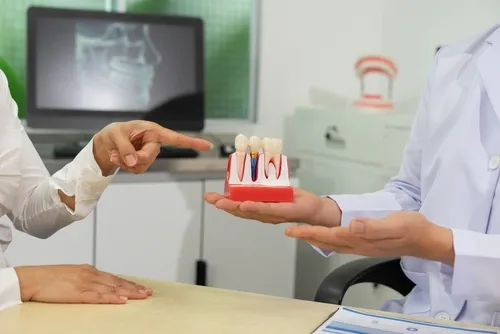
How Many Dental Implants Can You Get at One Time?
There is no set limit on how many dental implants you can get at one time, but most dentists place 2 to 8 implants per session. It’s common for patients to have a full arch (10-14 teeth) replaced during a single procedure.
The exact number of dental implants that’s right for you depends on several important factors. Every smile is unique, and your treatment plan will be tailored to your specific needs.
Jawbone Density
One of the most important considerations is the health and density of your jawbone. Dental implants need a strong foundation to fuse properly with the bone. Patients with dense, healthy bone may be able to receive multiple implants in one session, while those with lower bone density might need fewer implants at a time, or a bone graft beforehand to build a solid foundation.
Active infection or gum disease must be treated first to create a healthy foundation for implants.
Overall Health and Healing Capacity
Your general health affects how well your body can heal after surgery. Conditions such as diabetes, autoimmune disorders, or lifestyle factors like smoking can influence how many implants your dentist recommends placing at once. Spacing out procedures may be safer in some cases to allow for optimal healing.
Bite and Tooth Alignment
How your teeth come together, your bite, also impacts the number and placement of implants. A well-distributed bite can sometimes allow for fewer implants, while certain alignment or spacing challenges may require additional implants to achieve optimal function and comfort.
Extent of Tooth Loss and Dental Restoration Type
The number of teeth you’re replacing also plays a role. Replacing a single tooth or a small bridge can typically be done in one session, while full arch or full mouth restorations may require careful planning and sometimes staged placement to ensure proper alignment and stability.
Sedation Options
The type of sedation or anesthesia used during your dental implant procedure can also influence how many implants can be placed at one time. Procedures involving multiple implants often take longer, and advanced sedation options, such as IV sedation, can make it possible to complete more extensive treatment comfortably in a single visit. These options allow patients to remain relaxed or fully asleep while the dental team works efficiently and precisely, even during complex implant placements.
In some cases, it may be recommended to divide implant placement into multiple sessions to reduce physical stress and support proper healing. At The Foleck Center, your comfort and safety guide every decision, ensuring the right balance between completing treatment efficiently and achieving the best possible outcome.
Pros and Cons of Getting Multiple Dental Implants at Once
For many patients, having multiple dental implants placed in a single procedure can be an efficient and appealing option. However, like any medical or dental treatment, there are both benefits and considerations to keep in mind. Understanding the pros and cons can help you feel confident in your treatment decision.
Ultimately, the decision comes down to what is safest and most effective for your individual needs. A thorough consultation allows your dental team to weigh these factors and recommend an approach that balances comfort, healing, and long-lasting results.
Pros of Multiple Dental Implants in One Procedure
One of the biggest advantages is convenience. Placing several implants at once can reduce the total number of surgical appointments, meaning fewer days off work and fewer recovery periods. Many patients also appreciate the faster overall treatment timeline, especially when replacing an entire arch or full mouth of teeth. Additionally, a single procedure can sometimes be more cost-effective, as it may reduce anesthesia, surgical, and facility-related expenses over time.
Cons and Considerations
On the other hand, placing multiple implants in one session can involve a longer procedure and a more involved recovery. Some patients may experience increased swelling or discomfort compared to a single-implant placement, particularly in the first few days after surgery.
Not everyone is a candidate for extensive same-day implant placement, especially if there are health concerns, limited jawbone density, or a need for additional procedures like bone grafting. In these cases, spacing treatment over multiple sessions may lead to better healing and long-term success.
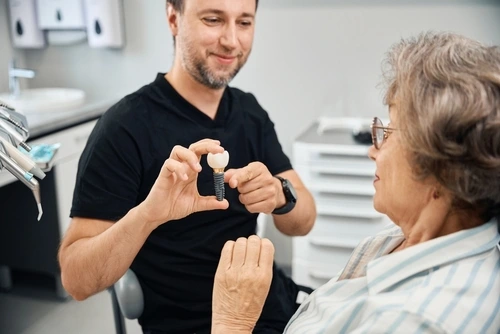
The Procedure for Multiple Dental Implants
Knowing what to expect can make the dental implant process feel far less intimidating, especially when multiple implants are involved. While every treatment plan is customized, most procedures follow a similar series of steps designed to ensure comfort, safety, and long-term success.
Step 1: Comprehensive Consultation and Planning
The process begins with a thorough consultation, including digital imaging and advanced diagnostics to evaluate your jawbone, bite, and overall oral health. Your dentist will determine how many implants can be placed at once and whether additional procedures—such as extractions or bone grafting—are needed. A personalized treatment plan is created so there are no surprises on the day of surgery.
Step 2: Sedation and Dental Implant Placement
On the day of your procedure, appropriate sedation or anesthesia is used to keep you comfortable. The dental implants are then carefully placed into the jawbone at precise angles and depths. For patients receiving multiple implants, this step may take longer, but modern techniques and technology allow for efficient and accurate placement, even in complex cases.
Step 3: Initial Healing and Recovery
After surgery, the gums and jawbone begin the healing process. Some swelling, soreness, or mild bruising is normal and typically subsides within a few days. Most patients can return to normal daily activities relatively quickly, though strenuous activity should be avoided for a short time.
Step 4: Osseointegration (Bone Healing Phase)
Over the next few months, the implants fuse with the jawbone through a process called osseointegration. This step is critical for long-term stability and usually takes about three to six months. During this time, temporary restorations may be used to maintain appearance and function.
Step 5: Final Restoration
Once healing is complete, custom crowns, bridges, or full-arch prosthetics are securely attached to the implants. These restorations are designed to look, feel, and function like natural teeth—allowing you to eat, speak, and smile with confidence.
By breaking the process into stages, your dental team ensures each implant has the best chance for success. While placing multiple implants may sound complex, a well-planned approach and proper healing time make it a predictable and highly effective solution for restoring your smile.
Contact the Foleck Center Today
If you’re considering dental implants and wondering how many teeth can be replaced at once, the next step is talking to an experienced dentist. At The Foleck Center, we take the time to understand your goals, evaluate your oral health, and create a personalized treatment plan.
Whether you’re missing one tooth or need a full smile restoration, our team is here to guide you every step of the way. Contact The Foleck Center today and take the first step toward a healthier, more confident smile.